Is Solar Expensive in India? Cost vs Benefits

Is Solar Expensive in India

If you’re thinking about installing a solar system in India to reduce your electricity bills, run ACs comfortably, or achieve energy independence, you’re in the right place. Many people wonder: Is solar expensive in India? The short answer is no, not anymore, especially with heavy government subsidies and excellent long-term returns. Let’s break it down in simple terms: costs, types, subsidies, savings, and benefits.

What Are Solar Panels?

Solar panels (also called solar plates or PV modules) work on the photovoltaic principle. “Photo” means light and “voltaic” means electricity. They convert sunlight directly into DC electricity. Since most Indian homes use AC power, an inverter converts DC to AC.

Solar panels typically last 25+ years, with newer ones performing well even after 30-35 years, though efficiency drops slightly over time.

Types of Solar Panels

There are mainly three types:

  • Polycrystalline (Blue colour): Cheapest option. Good for tight budgets but slightly lower efficiency.
  • Monocrystalline (Black colour): More efficient and popular for better performance.
  • Bifacial Monocrystalline: Premium choice. Generates power from both sides (top and reflected light from bottom). Higher output, especially in open areas.

Your choice depends on budget — mono or bifacial for better long-term results.

Types of Solar Systems in India

  1. On-Grid System (Most Popular for Homes): This works with your existing electricity connection. Solar power feeds into your home and the grid. When solar produces enough, your meter slows down or runs backwards (net metering). No batteries needed. Best for: Areas with reliable grid power. Government subsidies are mainly available for on-grid systems.
  2. Off-Grid System: Completely independent with batteries. Solar charges batteries, and the inverter supplies power. Ideal for remote areas, villages, or places with frequent power cuts. Drawback: Batteries need replacement every 5-8 years (they are consumables).
  3. Hybrid System: The best of both worlds. Works with grid + solar + battery backup. Runs on solar/grid when available and switches to battery during outages. Slightly more expensive but most versatile.

Is Solar Expensive? Real Cost Breakdown (2026)

For a typical 3kW On-Grid System (recommended for most 3-4 BHK homes):

  • Gross Cost: ₹1.75 lakh to ₹2.5 lakh (including panels, inverter, installation, etc.).
  • Central Government Subsidy (PM Surya Ghar Muft Bijli Yojana): ₹78,000 fixed for 3kW and above.
  • State Subsidies: Vary by state (e.g., some states like UP, Delhi offer extra ₹15,000–₹30,000+). Total subsidy can reach ₹1 lakh+ in supportive states.
  • Net Cost to You: Often ₹70,000 to ₹1.5 lakh depending on brand, location, and state incentives.

Payback Period: Usually 3 to 5 years. After that, it’s mostly free electricity for the next 20+ years.

Cost vs Benefits: The Savings Calculation

According to the video and general data:

  • 1kW system generates roughly ₹2,000–₹2,500 worth of electricity per month (at ₹7-8 per unit).
  • 3kW system can generate 360–450 units per month (12-15 units/day), saving ₹3,000 to ₹5,000+ per month or ₹40,000–₹60,000 per year.

Example for Average Home:

  • Monthly bill without solar: ₹4,000–₹6,000
  • With 3kW solar: Bill drops dramatically (often to ₹500–₹1,500 or zero in good months)
  • 25-year savings: Can easily cross ₹10–15 lakh (considering rising electricity tariffs).

For running ACs: A 3kW system can comfortably handle 1-1.5 ton AC + normal household load (fans, fridge, lights, TV).

Who Should Go for Solar?

  • On-Grid: Best for most city/town homes with good grid supply → maximum subsidy + fastest payback.
  • Hybrid: If you face frequent power cuts.
  • Off-Grid: Remote locations or complete independence.

Pro Tip: Start with 3kW for best subsidy value. You can always expand later, but subsidy is capped effectively after 3kW.

Final Verdict: Is Solar Worth It in India?

Absolutely yes. What looks like a big upfront cost becomes one of the smartest investments you can make. With subsidies making net cost very reasonable, rising electricity prices, and 25+ years of benefits, solar pays for itself quickly and then starts giving “profit” in the form of near-zero bills.
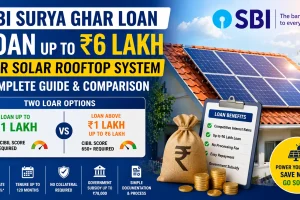
EMI Options for Solar Systems in India – SBI Surya Ghar

If you are planning to install a solar rooftop system at your home and thinking of taking a loan for it, then State Bank of India (SBI) can help you through its Surya Ghar Scheme. Under this scheme, SBI provides a loan for installing solar rooftop systems at very competitive interest rates compared to other regular loans.

SBI has designed two types of loans under the Surya Ghar Scheme for solar rooftop installation.

  • The first loan is available up to ₹1 lakh.
  • The second loan is available for amounts above ₹1 lakh and up to a maximum of ₹6 lakh.

In this article, we will do a side-by-side comparison of these two types of loans and understand the basic differences between them.

Purpose of the Loans
The first loan (up to ₹1 lakh) is meant for smaller solar rooftop projects.
The second loan is available if you want to take a loan between ₹1 lakh and ₹6 lakh.

Age and Eligibility Criteria
The age and eligibility criteria are the same for both types of loans.
For example, your age should not be more than 65 years. If you are taking the loan at the age of 65, the loan must be fully repaid by the time you reach 70 years of age.

If you have a co-borrower along with the individual borrower, then the loan must be fully repaid before the borrower reaches 75 years of age.

CIBIL Score Requirement
The CIBIL requirements differ for both loans.

  • For loans up to ₹1 lakh, the bank does not check your CIBIL score.
  • However, if the loan amount is more than ₹2 lakh, your CIBIL score must be a minimum of 650.

Customers who have had any default or loan write-off in the past will not be eligible for this loan from SBI.

Roof Ownership
The most important condition is that the roof on which you want to install the solar system must be owned by you. You can only install the solar rooftop on your own roof, and the loan is given against that.

Other Important Requirements

  • You must have sufficient roof area as per the guidelines issued by the Ministry of New and Renewable Energy (MNRE).
  • Your latest electricity bill is required.
  • You must have a savings account with SBI.

For loans up to ₹2 lakh, PAN card is not mandatory. However, if the loan amount is more than ₹2 lakh, PAN card is mandatory.

Margin Money
In both cases, the bank does not finance 100% of the project cost. You will have to contribute a 10% margin. For example, if your total project cost is ₹100, the bank will finance only ₹90.

Interest Rates

  • For loans up to ₹2 lakh: Interest rate is 6%.
  • For loans above ₹2 lakh: Interest rate is 8.15%.

Loan Tenure
You can repay the loan in a maximum of 120 months (10 years). There is no minimum tenure fixed. You can prepay the loan at any time without any prepayment penalty from the bank.

Security
You do not need to provide any additional security. The solar rooftop system installed on your roof will remain as hypothecation with the bank until the loan is fully repaid. This is similar to the hypothecation arrangement in a car loan.

Processing Fee
There is no processing fee or file charge for this loan.

Government Subsidy
The Government of India also provides subsidy on solar rooftop installation under this scheme:

  • For 1 kW solar rooftop: ₹30,000 subsidy
  • For 2 kW solar rooftop: ₹60,000 subsidy
  • For 3 kW solar rooftop: ₹78,000 subsidy

If your loan amount is more than ₹2 lakh, it will usually be for a project of 3 kW or above, and you will be eligible for the full ₹78,000 subsidy.

Income Requirement

  • For loans up to ₹1 lakh: Annual income is not considered.
  • For loans above ₹2 lakh: Minimum annual income of ₹3 lakh is required.

Documents Required
In both cases, you need to submit KYC documents and your latest electricity bill.

If the loan amount is more than ₹1 lakh, additional documents are required, such as:

  • Proof of income (ITR returns and Form 16 for the last 2 years)
  • Salary account statement for the last 6 months

Moratorium Period
A moratorium period of up to 6 months may be offered, during which you do not need to pay any instalments.

Loan Disbursement Process
The loan amount is disbursed directly to the vendor from whom you are purchasing and installing the solar system.

How to Apply
The basic process to apply for the SBI Surya Ghar Loan is as follows:

  1. First, register on pmsy.gov.in
  2. After successful registration, apply for the loan on www.jsarth.in
  3. Submit all the required documents to the bank.
  4. The bank will sanction the loan after checking your eligibility.

If you have any more doubts about the SBI Surya Ghar Loan, you can ask in the comment section below.