If you’re thinking about installing a solar system in India to reduce your electricity bills, run ACs comfortably, or achieve energy independence, you’re in the right place. Many people wonder: Is solar expensive in India? The short answer is no, not anymore, especially with heavy government subsidies and excellent long-term returns. Let’s break it down in simple terms: costs, types, subsidies, savings, and benefits.
What Are Solar Panels?
Solar panels (also called solar plates or PV modules) work on the photovoltaic principle. “Photo” means light and “voltaic” means electricity. They convert sunlight directly into DC electricity. Since most Indian homes use AC power, an inverter converts DC to AC.
Solar panels typically last 25+ years, with newer ones performing well even after 30-35 years, though efficiency drops slightly over time.
Types of Solar Panels
There are mainly three types:
Polycrystalline (Blue colour): Cheapest option. Good for tight budgets but slightly lower efficiency.
Monocrystalline (Black colour): More efficient and popular for better performance.
Bifacial Monocrystalline: Premium choice. Generates power from both sides (top and reflected light from bottom). Higher output, especially in open areas.
Your choice depends on budget — mono or bifacial for better long-term results.
Types of Solar Systems in India
On-Grid System (Most Popular for Homes): This works with your existing electricity connection. Solar power feeds into your home and the grid. When solar produces enough, your meter slows down or runs backwards (net metering). No batteries needed. Best for: Areas with reliable grid power. Government subsidies are mainly available for on-grid systems.
Off-Grid System: Completely independent with batteries. Solar charges batteries, and the inverter supplies power. Ideal for remote areas, villages, or places with frequent power cuts. Drawback: Batteries need replacement every 5-8 years (they are consumables).
Hybrid System: The best of both worlds. Works with grid + solar + battery backup. Runs on solar/grid when available and switches to battery during outages. Slightly more expensive but most versatile.
Is Solar Expensive? Real Cost Breakdown (2026)
For a typical 3kW On-Grid System (recommended for most 3-4 BHK homes):
For running ACs: A 3kW system can comfortably handle 1-1.5 ton AC + normal household load (fans, fridge, lights, TV).
Who Should Go for Solar?
On-Grid: Best for most city/town homes with good grid supply → maximum subsidy + fastest payback.
Hybrid: If you face frequent power cuts.
Off-Grid: Remote locations or complete independence.
Pro Tip: Start with 3kW for best subsidy value. You can always expand later, but subsidy is capped effectively after 3kW.
Final Verdict: Is Solar Worth It in India?
Absolutely yes. What looks like a big upfront cost becomes one of the smartest investments you can make. With subsidies making net cost very reasonable, rising electricity prices, and 25+ years of benefits, solar pays for itself quickly and then starts giving “profit” in the form of near-zero bills.
Electricity bills of ₹3000, ₹5000, ₹7000 and even more during summer have become common in many Indian homes. Rising power costs are making homeowners, creators, and businesses look seriously at solar energy. Even today, many people hesitate because of myths and misunderstandings about solar power systems.
The reality is that solar technology has improved dramatically over the years. Costs have reduced, efficiency has improved, and government support has made rooftop solar more practical and accessible for Indian households. Still, many myths continue to create confusion.
Here are some of the most common solar myths in India and the truth behind them.
Myth 1: Solar does not work in cold or cloudy places
Many people think solar panels only work in extreme heat or direct sunlight. This is not true. Solar panels work almost anywhere there is daylight. Even cloudy countries like Germany use large amounts of solar power successfully.
Solar panels continue generating electricity during cloudy weather, rain, and winter. Output may reduce slightly, but generation does not stop. Panels can still produce around 10% to 25% of their normal output on cloudy days because they also capture diffuse sunlight.
In a country like India, where most regions receive sunlight for nearly 300 days a year, solar is a reliable energy solution.
Myth 2: Rooftop solar is too expensive
This is one of the biggest myths in India. Many people believe installing rooftop solar requires a huge investment of ₹2 to ₹3 lakh and is difficult to afford.
But solar prices have dropped drastically over the last decade. Government subsidies further reduce installation costs. Under the PM Surya Ghar Muft Bijli Yojana, homeowners installing 3 kW or larger rooftop solar systems can receive subsidies up to ₹78,000 from the central government.
Several state governments also provide additional support. Delhi, Assam, and Uttar Pradesh are among the states offering extra subsidies to encourage solar adoption.
Financing options are also available. Government banks provide loans for rooftop solar systems at relatively low interest rates, making installations easier for middle-class families.
Most importantly, rooftop solar is not just an expense. It is an investment. A properly designed system can recover its cost in around 3 to 7 years and then continue generating electricity for 20 to 25 years with very low operating costs.
Myth 3: Solar is only for rich people
Many people assume solar systems are only meant for villas, luxury homes, or wealthy families. Today, that is no longer true.
Solar has become practical and accessible for middle-class households as well. If a home has a monthly electricity bill of ₹1500 or more, rooftop solar can significantly reduce electricity expenses. In many cases, bills can reduce by up to 90%.
Community solar projects, leasing models, loans, and subsidies are making solar adoption possible even for lower-income households.
Myth 4: Solar stops working after sunset
Solar panels generate electricity during the daytime, but that does not mean your home becomes powerless at night.
Homes connected to the grid continue receiving electricity after sunset. Excess solar energy generated during the day can also offset nighttime usage through net metering. Hybrid systems with battery backup can provide power even during power cuts.
Solar energy can also charge electric vehicles during the day for later use.
Myth 5: Solar panels absorb all sunlight and harm agriculture
This is false. Solar panels convert only around 20% of sunlight into electricity. Most sunlight is reflected or passes through. Solar installations generally have minimal impact on nearby gardens or farming.
In many cases, solar panels and agriculture can coexist successfully.
Myth 6: Solar panel manufacturing creates huge toxic waste
A common misconception is that solar panels are highly toxic. In reality, more than 95% of solar panel materials, including glass and silicon, are reusable and non-toxic.
Proper recycling systems can safely handle the remaining electronic waste.
Myth 7: Solar farms require huge amounts of land
People often think solar power needs massive land areas. In reality, rooftop spaces, parking lots, warehouses, and unused land can all be utilized for solar generation.
Large-scale solar is actually highly efficient in terms of energy produced per acre.
Myth 8: Solar manufacturing consumes too much energy
Solar systems usually recover the energy used in their manufacturing within 1 to 4 years. After that, they continue producing clean electricity for 25 years or more.
This makes solar one of the most efficient long-term clean energy technologies available today.
Myth 9: Solar only works because of subsidies
Solar costs have fallen so much that in many regions solar power is now cheaper than electricity generated from coal or gas, even without subsidies.
Government support helps accelerate adoption, but solar itself has already become economically viable.
Myth 10: Solar power is unreliable because it is intermittent
Modern forecasting systems, grid coordination, battery storage, and better distribution networks have significantly reduced intermittency concerns.
A properly designed solar system can reliably support household loads including ACs, geysers, water pumps, refrigerators, televisions, laptops, and EV chargers.
Myth 11: Solar cannot power an entire house
This is another major misconception. If the system is designed properly based on past electricity usage and future needs, solar can handle the complete load of a home. Hybrid systems with batteries can also support essential appliances during power cuts.
Myth 12: Solar panels need direct sunlight to work
Solar panels do not depend only on direct sunlight. They also work using diffuse sunlight available during cloudy or hazy conditions. Panel positioning and system design are often more important than constant direct sunlight.
Myth 13: Rooftop solar makes the power grid unstable
Proper engineering and modern smart inverters help maintain grid stability. In many cases, solar systems actually support voltage stabilization.
Myth 14: Solar is harmful to birds and wildlife
Studies show solar farms generally cause far fewer bird deaths compared to buildings, vehicles, and power lines. Responsible solar development can coexist with wildlife conservation.
Myth 15: Failed solar panels become toxic waste
Even after years of usage, most panel materials remain recyclable. Proper recycling systems can recover glass, aluminum, and silicon for reuse.
Myth 16: Batteries are mandatory for solar systems
Batteries are useful, especially during power cuts, but they are not essential for all solar systems. Grid-connected systems can operate effectively without batteries using net metering arrangements.
Myth 17: Solar will never become a major energy source
Solar energy is already contributing significantly to electricity generation across many parts of the world. Its share continues to grow rapidly because installation is faster and more scalable than many traditional energy sources.
Myth 18: Solar panels lose efficiency very quickly
All technologies experience some degradation over time, but quality solar panels usually lose less than 1% efficiency per year. Even after 25 years, many panels continue operating at more than 80% efficiency.
Myth 19: Solar systems require zero maintenance
Solar systems are low-maintenance, but not maintenance-free. Panels need periodic cleaning and occasional inspections to maintain optimal performance. Just like servicing a bike, car, or air conditioner, basic maintenance helps improve long-term efficiency and reliability.
Myth 20: It is better to wait because solar will become cheaper later
This is often the costliest mistake. Every month spent delaying solar installation means continued spending on high electricity bills. At the same time, government subsidy schemes may not remain available forever or may have limited coverage.
Instead of waiting endlessly for future price reductions, many homeowners can start saving immediately by switching to solar now.
The Reality About Solar in India
Solar power has become more affordable, efficient, and practical than ever before. Many myths still prevent people from adopting it, even though it can reduce dependence on the grid, lower electricity bills, and provide long-term financial savings.
Whether you are a homeowner, business owner, content creator, or someone simply tired of rising electricity bills, understanding the facts about solar can help you make a better decision.
The biggest obstacle today is often not technology or affordability, but misinformation.
I often get this question: “How many units of electricity does 1 kilowatt system actually generate in one day?”
In this detailed test, we answer that question by monitoring our current setup: two Waaree 575 W solar panels (total ~1.15 kW nameplate capacity) in an off-grid configuration. We tracked generation from early morning until late afternoon on 7 March to see the real maximum daily units produced.
Current Setup and Time of Observation
Time right now: 6:30 AM
Date: 7 March
Panels: 2 × Waaree 575 W (±2 W tolerance) – freshly cleaned this morning
Batteries: 4 batteries (approximately 24 V system)
Inverter: Normal 2 kVA inverter (not a pure solar hybrid)
Charge controller: MPPT charge controller in use
Key Factor: Battery Full → Generation Stops (Off-Grid Reality)
Electricity generation in an off-grid system depends on many factors. Importantly, if there is no proper battery bank or if the batteries reach full charge early, the system stops producing usable power even when the sun is shining brightly.
In our case, with four batteries, they typically become fully charged by around 12:00–12:30 PM. After that point, any additional solar power is essentially wasted (curtailed) because there is nowhere to store it and no large enough load to consume it.
Today’s goal was to minimize that wastage: once the batteries reached full charge, we deliberately connected maximum possible household load to utilize as much of the available solar power as possible and measure the true peak daily output.
Morning Check: Panel Specifications & Initial Charging
The panels are completely neat and clean (cleaned this morning). You can see residual water droplets in some shots — we do clean them regularly despite what some comments suggest.
Brand: Waaree
Rated wattage (front & back label): 575 W ±2 W
At 6:30 AM with light sunlight just starting:
Charging current to battery: ~1.2 A
Solar input: ~6.7 A
Instant power: ~24 W
Total generation so far this month (five months of data): around 7 units.
Mid-Morning Progress (Around 10–11 AM)
By ~10:06 AM:
Charging amps: ~30.4 A (from panels)
Incoming amps to battery: ~21 A
Battery voltage: ~26.9 V
Instant power from panels: ~780 W
By ~11:00 AM:
Charging amps dropped to ~3.3 A
Battery nearing 50% → expected to reach full in another 30–60 minutes
Instant power from panels: 924 W
Battery Full – Maximum Load Test (Around 12 PM)
At approximately 12:00 PM the battery reached full charge:
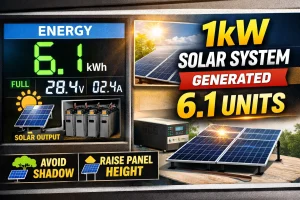
Battery voltage: 28.4 V (completely full – solar full indicator ON)
Still receiving 924 W from panels
Units generated so far: 2.7 units (with ~200 W average house load running during charging)
From this point we applied maximum realistic household load to consume the surplus solar power:
Loads turned ON (approximate breakdown)
Rod heaters (2 nos.)
LED bulbs across rooms (7 total, including 24/7 ones)
Ceiling fans (multiple)
Cooler (~200 W)
False ceiling lights (4 × 12 W = 48 W)
Tube lights
Monitor (runs 6 AM – 10/11 PM daily)
Fridge (was already running earlier)
Additional test lights
Inverter load reading after maximum load: ~33%
Afternoon Snapshot (Around 4:18 PM)
Time: 4:18 PM
Battery: Still showing 28.4 V (full)
House load running: ~10 A / 200–300 W
Panels still contributing ~200–300 W
Total units generated: 5.9 (almost 6 units)
Final Reading (Evening – 5:53 PM)
Time: 5:53 PM
Total units generated for the day: 6.1 units
Very small charging (~1 A) still occurring
Summary of Results
From a ~1 kW (actually 1.15 kWp) off-grid solar setup with four batteries and a normal inverter, we generated 6.1 units on 7 March.
Had the panels been mounted higher (say 8 feet above ground), we estimate an additional 20–30% output was possible — potentially reaching around 7 units per day in similar conditions.
Why Not Higher Output? Two Main Reasons Observed
Wall shadow in late afternoon — As evening approaches, the nearby wall casts a shadow across the panels, reducing effective generation.
Tree shadow in early morning — Until around 8:00 AM, tree shade falls on the panels, delaying peak production.
Recommendations for Better Output
If you want to maximize units from a similar setup:
Install panels on a proper stand / higher elevation (at least 8 feet from ground) to avoid ground-level obstructions and shadows.
Consider a pure solar hybrid inverter for better direct utilization.
Size the battery bank larger if you frequently see early full-charge curtailment.
We hope this real-world test gives you a clear idea of what a 1 kW-class off-grid system can realistically deliver in everyday home use.
If you found this helpful, feel free to share your own solar generation numbers or setup questions in the comments!
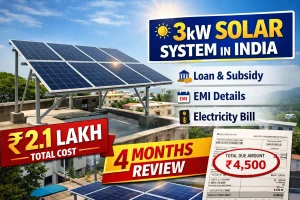
For the last four months, a 3 kW solar system has been in use at home, so sharing a complete experience and review. This includes how the bank loan process works, what documents are required, EMI details, subsidy timeline, and a few practical things that only become clear after installation.
Solar usually makes sense for households where the electricity bill is above ₹1000 to ₹1500 per month. Earlier, during summer months, the bill used to touch ₹4000, and in normal months it stayed above ₹1500. Because of that, installing solar felt like a practical decision. Instead of paying the electricity bill every month, the idea was to pay around ₹2000 EMI and own a solar system.
Applying for solar
Applications are done through the PM Surya Ghar Yojana portal. The process is online, but in reality most of the work is handled by the local distributor. Once contacted, they usually guide through the entire process.
Before deciding, enquiries were made with other companies including Tata and Truzen. Finally a local installer was preferred because service and support are easier when the company is nearby.
Cost of the 3 kW system
The total cost for this 3 kW solar setup was around ₹2,10,000.
Loan taken: ₹1,89,000
Cash paid: ₹21,000
The amount someone pays directly depends on their loan eligibility. Full payment is not compulsory.
Some installers offer systems between ₹1.8 lakh and ₹2.1 lakh. Price differences usually depend on the type and quality of panels used.
Bank loan process
After applying on the PM Surya Ghar portal, the next step is applying for a bank loan. At present, loans for this scheme are mainly provided by government banks like Indian Bank and Indian Overseas Bank.
The process usually takes 2 to 3 days if all documents are ready.
Required documents include:
Aadhaar card
PAN card
Own house proof
Solar under this scheme can only be installed on an owned house. It cannot be installed on rented houses. Also, the loan must be applied in the same name as the electricity bill holder.
At the bank, an account is opened and loan forms are filled. Around 40 to 50 signatures may be required during the process.
After that, bank officials visit the house for verification. They check whether the property is owned and also take photos of the location where solar panels will be installed. Once verification is completed, the loan is usually sanctioned within 4 to 5 days.
The loan amount is transferred directly to the solar distributor’s account, while the government subsidy is credited to the customer’s bank account.
Installation details
Once the loan is approved, installation starts quickly.
In this case, Polycab materials were used along with premium bifacial solar panels. Bifacial panels generate electricity from both sides, which helps improve overall output.
One important suggestion during installation is about the panel structure height. Many installers offer a 6 x 4 structure, which sits lower on the terrace. But installing a higher 8 x 6 structure is better if space allows. A higher structure keeps the terrace usable and prevents the entire roof area from being blocked.
It is also better to clearly discuss the following things with the installer before paying:
Structure height
Panel type
Cement support blocks for pillars
Once payment is done, negotiating later becomes difficult. Getting the details written clearly helps avoid confusion.
Smart meter installation
After the solar setup is completed, the electricity department installs a smart meter. The old meter is removed and replaced with a new one. The service number remains the same and electricity billing continues as usual.
Once the smart meter is installed, the solar system starts functioning.
On grid solar behaviour
This system is on grid solar. One important thing to understand is that solar generation happens only when grid electricity is available. Even if sunlight is strong, the panels will not operate during a power cut.
Off grid systems work differently because they include batteries, but they are more expensive. Hybrid systems combining both technologies are also available now, though they cost more.
Monitoring power generation
The installer provides a mobile app where solar generation can be checked.
Through the app it is possible to track:
Daily power generation
Monthly unit generation
At present, with mixed weather conditions and some rainfall, the system generates around 380 to 400 units per month. During peak summer the highest daily generation recorded was 19 units in one day.
Keeping the panels clean is very important. Dust collects on rooftop panels and affects output. Cleaning them once a week with water helps maintain good power generation.
Subsidy timeline
The government subsidy was credited within about 45 days directly to the bank account. That amount was used to reduce the loan balance.
Subsidy timelines may vary depending on government processing. Sometimes it may come earlier, sometimes later.
First electricity bill surprise
After installing solar, many people expect the electricity bill to become zero immediately. But the first bill can be around ₹4500 because the cost of the smart meter installation is included in that bill.
From the next month onwards the bill reduces significantly, but it does not become completely zero.
Even with solar installed, there are still fixed charges and FCA charges. These charges come to around ₹300 to ₹350 per month.
Earlier these charges were around ₹150 to ₹160, but they increased later. Because of this, even solar users continue to receive a small monthly bill.
So expecting a completely zero electricity bill may not be realistic. Energy charges become zero, but other charges still remain.
EMI and loan repayment
The EMI initially was ₹2195, but after the RBI repo rate reduction, the interest dropped and the EMI reduced to around ₹2000.
After adjusting the subsidy amount, the remaining loan repayment period is around 4.5 years.
The bank app clearly shows:
EMI amount
Due date
Loan balance
Timely repayment is important because it affects the CIBIL score.
Overall experience after four months
The main reason for installing solar was a monthly electricity bill above ₹1500. Solar panels typically have a life of around 25 years, while the loan gets cleared within about five years. The expectation was that the remaining years would bring long term savings.
However, because of fixed charges of around ₹300 to ₹350 per month, the bill never becomes completely zero. Earlier the higher bills mostly came during summer months. Now the bill stays small but consistent every month.
Apart from that, the system has been working well. In the first four months there have been no technical issues with the solar panels or installation.
Extra unused solar units are supposed to be settled every three to six months, according to the distributor. Whether the amount actually gets credited depends on the electricity department and settlement cycle.
Final thoughts
Solar can still be a good option for homes with consistently high electricity bills, especially above ₹1500 per month. But it is better to install it with realistic expectations.
The electricity bill may reduce a lot, but some monthly charges will still remain. Proper installation, good panel quality, and regular cleaning make a big difference in performance.
The installation discussed here was done in AP and this review reflects the experience after using the system for about four months.