Recently, some important announcements related to the PM KUSUM scheme have also been made. Has the government ensured benefits for common people and farmers in it? Will 2026 see the highest number of solar panel installations ever?
Now that the budget is out, the big question is what has the solar industry received from this budget? In the coming days, will installing a solar panel system at home become cheaper or more expensive? Will subsidy be reduced or increased? And what announcements have been made regarding the PM KUSUM scheme? Has the government taken care of your benefits?
The government has laid out a complete roadmap for the solar sector in this budget. Let me explain everything in detail.
Major Announcements in Budget 2026 for Solar Sector
1. PM KUSUM Scheme 2.0 – Big Boost for Farmers
The government has announced PM KUSUM 2.0. The budget allocation for this scheme has been increased by 45%.
Subsidy for solar pumps used for irrigation has been increased.
Farmers can now install solar panel systems on barren land up to 2 MW capacity.
Approximately ₹500 crore has been allocated for this, which is a 45% increase from before.
This means the PM KUSUM scheme will now move forward at a much faster pace. Many farmers are already earning good income (₹6–7 lakh per month) by installing solar plants on their land. With this increased funding, more farmers can now benefit and increase their earnings significantly.
2. PM Surya Ghar Scheme – Higher Subsidy
Good news for homeowners! The subsidy under the PM Surya Ghar Muft Bijli Yojana has also been increased.
Earlier, for a 3 kW rooftop solar system, you used to get ₹78,000 subsidy.
Now, for a 2 kW system, the subsidy has been increased to ₹80,000.
For 1 kW system, subsidy was around ₹30,000 earlier. For 2 kW, it was ₹60,000. The government has now increased the subsidy amount by nearly ₹20,000.
This will make rooftop solar systems much more affordable for common people.
3. Strong Push for Domestic Solar Manufacturing
To promote “Make in India” in solar, the government has allocated ₹24,000 crore under the PLI (Production Linked Incentive) Scheme.
Earlier allocation was ₹19,000 crore.
Now it has been increased to ₹24,000 crore.
This will encourage more companies to set up solar panel and solar cell manufacturing factories in India.
4. Focus on Battery Storage (BESS)
The government has also proposed to reduce GST on Battery Energy Storage Systems (BESS). Earlier, hybrid and storage-based solar systems had 18% GST, while normal solar products had only 5%. Reducing GST on storage systems will make hybrid and off-grid solar systems cheaper in the coming days.
What Does This Mean for You?
Installing solar panel systems is going to become more attractive and affordable in 2026.
Farmers can earn extra income through PM KUSUM by installing solar plants on their land.
Homeowners will get higher subsidy under PM Surya Ghar scheme.
Domestic manufacturing is being strongly encouraged, which will help reduce dependence on imported panels in the long run.
I believe 2026 will see the highest number of solar installations in India so far.
My Advice
If you have not yet applied for solar under the PM Surya Ghar Yojana, don’t delay. Register yourself immediately on the official website: pmsuryaghar.gov.in
The more people apply, the longer the waiting time may become. So register early and take maximum advantage of the subsidy. The money you invest will recover quickly through electricity bill savings.
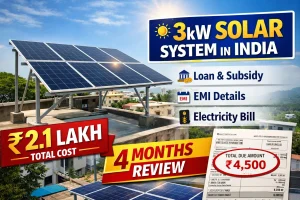
For the last four months, a 3 kW solar system has been in use at home, so sharing a complete experience and review. This includes how the bank loan process works, what documents are required, EMI details, subsidy timeline, and a few practical things that only become clear after installation.
Solar usually makes sense for households where the electricity bill is above ₹1000 to ₹1500 per month. Earlier, during summer months, the bill used to touch ₹4000, and in normal months it stayed above ₹1500. Because of that, installing solar felt like a practical decision. Instead of paying the electricity bill every month, the idea was to pay around ₹2000 EMI and own a solar system.
Applying for solar
Applications are done through the PM Surya Ghar Yojana portal. The process is online, but in reality most of the work is handled by the local distributor. Once contacted, they usually guide through the entire process.
Before deciding, enquiries were made with other companies including Tata and Truzen. Finally a local installer was preferred because service and support are easier when the company is nearby.
Cost of the 3 kW system
The total cost for this 3 kW solar setup was around ₹2,10,000.
Loan taken: ₹1,89,000
Cash paid: ₹21,000
The amount someone pays directly depends on their loan eligibility. Full payment is not compulsory.
Some installers offer systems between ₹1.8 lakh and ₹2.1 lakh. Price differences usually depend on the type and quality of panels used.
Bank loan process
After applying on the PM Surya Ghar portal, the next step is applying for a bank loan. At present, loans for this scheme are mainly provided by government banks like Indian Bank and Indian Overseas Bank.
The process usually takes 2 to 3 days if all documents are ready.
Required documents include:
Aadhaar card
PAN card
Own house proof
Solar under this scheme can only be installed on an owned house. It cannot be installed on rented houses. Also, the loan must be applied in the same name as the electricity bill holder.
At the bank, an account is opened and loan forms are filled. Around 40 to 50 signatures may be required during the process.
After that, bank officials visit the house for verification. They check whether the property is owned and also take photos of the location where solar panels will be installed. Once verification is completed, the loan is usually sanctioned within 4 to 5 days.
The loan amount is transferred directly to the solar distributor’s account, while the government subsidy is credited to the customer’s bank account.
Installation details
Once the loan is approved, installation starts quickly.
In this case, Polycab materials were used along with premium bifacial solar panels. Bifacial panels generate electricity from both sides, which helps improve overall output.
One important suggestion during installation is about the panel structure height. Many installers offer a 6 x 4 structure, which sits lower on the terrace. But installing a higher 8 x 6 structure is better if space allows. A higher structure keeps the terrace usable and prevents the entire roof area from being blocked.
It is also better to clearly discuss the following things with the installer before paying:
Structure height
Panel type
Cement support blocks for pillars
Once payment is done, negotiating later becomes difficult. Getting the details written clearly helps avoid confusion.
Smart meter installation
After the solar setup is completed, the electricity department installs a smart meter. The old meter is removed and replaced with a new one. The service number remains the same and electricity billing continues as usual.
Once the smart meter is installed, the solar system starts functioning.
On grid solar behaviour
This system is on grid solar. One important thing to understand is that solar generation happens only when grid electricity is available. Even if sunlight is strong, the panels will not operate during a power cut.
Off grid systems work differently because they include batteries, but they are more expensive. Hybrid systems combining both technologies are also available now, though they cost more.
Monitoring power generation
The installer provides a mobile app where solar generation can be checked.
Through the app it is possible to track:
Daily power generation
Monthly unit generation
At present, with mixed weather conditions and some rainfall, the system generates around 380 to 400 units per month. During peak summer the highest daily generation recorded was 19 units in one day.
Keeping the panels clean is very important. Dust collects on rooftop panels and affects output. Cleaning them once a week with water helps maintain good power generation.
Subsidy timeline
The government subsidy was credited within about 45 days directly to the bank account. That amount was used to reduce the loan balance.
Subsidy timelines may vary depending on government processing. Sometimes it may come earlier, sometimes later.
First electricity bill surprise
After installing solar, many people expect the electricity bill to become zero immediately. But the first bill can be around ₹4500 because the cost of the smart meter installation is included in that bill.
From the next month onwards the bill reduces significantly, but it does not become completely zero.
Even with solar installed, there are still fixed charges and FCA charges. These charges come to around ₹300 to ₹350 per month.
Earlier these charges were around ₹150 to ₹160, but they increased later. Because of this, even solar users continue to receive a small monthly bill.
So expecting a completely zero electricity bill may not be realistic. Energy charges become zero, but other charges still remain.
EMI and loan repayment
The EMI initially was ₹2195, but after the RBI repo rate reduction, the interest dropped and the EMI reduced to around ₹2000.
After adjusting the subsidy amount, the remaining loan repayment period is around 4.5 years.
The bank app clearly shows:
EMI amount
Due date
Loan balance
Timely repayment is important because it affects the CIBIL score.
Overall experience after four months
The main reason for installing solar was a monthly electricity bill above ₹1500. Solar panels typically have a life of around 25 years, while the loan gets cleared within about five years. The expectation was that the remaining years would bring long term savings.
However, because of fixed charges of around ₹300 to ₹350 per month, the bill never becomes completely zero. Earlier the higher bills mostly came during summer months. Now the bill stays small but consistent every month.
Apart from that, the system has been working well. In the first four months there have been no technical issues with the solar panels or installation.
Extra unused solar units are supposed to be settled every three to six months, according to the distributor. Whether the amount actually gets credited depends on the electricity department and settlement cycle.
Final thoughts
Solar can still be a good option for homes with consistently high electricity bills, especially above ₹1500 per month. But it is better to install it with realistic expectations.
The electricity bill may reduce a lot, but some monthly charges will still remain. Proper installation, good panel quality, and regular cleaning make a big difference in performance.
The installation discussed here was done in AP and this review reflects the experience after using the system for about four months.