If you’re thinking about installing a solar system in India to reduce your electricity bills, run ACs comfortably, or achieve energy independence, you’re in the right place. Many people wonder: Is solar expensive in India? The short answer is no, not anymore, especially with heavy government subsidies and excellent long-term returns. Let’s break it down in simple terms: costs, types, subsidies, savings, and benefits.
What Are Solar Panels?
Solar panels (also called solar plates or PV modules) work on the photovoltaic principle. “Photo” means light and “voltaic” means electricity. They convert sunlight directly into DC electricity. Since most Indian homes use AC power, an inverter converts DC to AC.
Solar panels typically last 25+ years, with newer ones performing well even after 30-35 years, though efficiency drops slightly over time.
Types of Solar Panels
There are mainly three types:
Polycrystalline (Blue colour): Cheapest option. Good for tight budgets but slightly lower efficiency.
Monocrystalline (Black colour): More efficient and popular for better performance.
Bifacial Monocrystalline: Premium choice. Generates power from both sides (top and reflected light from bottom). Higher output, especially in open areas.
Your choice depends on budget — mono or bifacial for better long-term results.
Types of Solar Systems in India
On-Grid System (Most Popular for Homes): This works with your existing electricity connection. Solar power feeds into your home and the grid. When solar produces enough, your meter slows down or runs backwards (net metering). No batteries needed. Best for: Areas with reliable grid power. Government subsidies are mainly available for on-grid systems.
Off-Grid System: Completely independent with batteries. Solar charges batteries, and the inverter supplies power. Ideal for remote areas, villages, or places with frequent power cuts. Drawback: Batteries need replacement every 5-8 years (they are consumables).
Hybrid System: The best of both worlds. Works with grid + solar + battery backup. Runs on solar/grid when available and switches to battery during outages. Slightly more expensive but most versatile.
Is Solar Expensive? Real Cost Breakdown (2026)
For a typical 3kW On-Grid System (recommended for most 3-4 BHK homes):
For running ACs: A 3kW system can comfortably handle 1-1.5 ton AC + normal household load (fans, fridge, lights, TV).
Who Should Go for Solar?
On-Grid: Best for most city/town homes with good grid supply → maximum subsidy + fastest payback.
Hybrid: If you face frequent power cuts.
Off-Grid: Remote locations or complete independence.
Pro Tip: Start with 3kW for best subsidy value. You can always expand later, but subsidy is capped effectively after 3kW.
Final Verdict: Is Solar Worth It in India?
Absolutely yes. What looks like a big upfront cost becomes one of the smartest investments you can make. With subsidies making net cost very reasonable, rising electricity prices, and 25+ years of benefits, solar pays for itself quickly and then starts giving “profit” in the form of near-zero bills.
Electricity bills of ₹3000, ₹5000, ₹7000 and even more during summer have become common in many Indian homes. Rising power costs are making homeowners, creators, and businesses look seriously at solar energy. Even today, many people hesitate because of myths and misunderstandings about solar power systems.
The reality is that solar technology has improved dramatically over the years. Costs have reduced, efficiency has improved, and government support has made rooftop solar more practical and accessible for Indian households. Still, many myths continue to create confusion.
Here are some of the most common solar myths in India and the truth behind them.
Myth 1: Solar does not work in cold or cloudy places
Many people think solar panels only work in extreme heat or direct sunlight. This is not true. Solar panels work almost anywhere there is daylight. Even cloudy countries like Germany use large amounts of solar power successfully.
Solar panels continue generating electricity during cloudy weather, rain, and winter. Output may reduce slightly, but generation does not stop. Panels can still produce around 10% to 25% of their normal output on cloudy days because they also capture diffuse sunlight.
In a country like India, where most regions receive sunlight for nearly 300 days a year, solar is a reliable energy solution.
Myth 2: Rooftop solar is too expensive
This is one of the biggest myths in India. Many people believe installing rooftop solar requires a huge investment of ₹2 to ₹3 lakh and is difficult to afford.
But solar prices have dropped drastically over the last decade. Government subsidies further reduce installation costs. Under the PM Surya Ghar Muft Bijli Yojana, homeowners installing 3 kW or larger rooftop solar systems can receive subsidies up to ₹78,000 from the central government.
Several state governments also provide additional support. Delhi, Assam, and Uttar Pradesh are among the states offering extra subsidies to encourage solar adoption.
Financing options are also available. Government banks provide loans for rooftop solar systems at relatively low interest rates, making installations easier for middle-class families.
Most importantly, rooftop solar is not just an expense. It is an investment. A properly designed system can recover its cost in around 3 to 7 years and then continue generating electricity for 20 to 25 years with very low operating costs.
Myth 3: Solar is only for rich people
Many people assume solar systems are only meant for villas, luxury homes, or wealthy families. Today, that is no longer true.
Solar has become practical and accessible for middle-class households as well. If a home has a monthly electricity bill of ₹1500 or more, rooftop solar can significantly reduce electricity expenses. In many cases, bills can reduce by up to 90%.
Community solar projects, leasing models, loans, and subsidies are making solar adoption possible even for lower-income households.
Myth 4: Solar stops working after sunset
Solar panels generate electricity during the daytime, but that does not mean your home becomes powerless at night.
Homes connected to the grid continue receiving electricity after sunset. Excess solar energy generated during the day can also offset nighttime usage through net metering. Hybrid systems with battery backup can provide power even during power cuts.
Solar energy can also charge electric vehicles during the day for later use.
Myth 5: Solar panels absorb all sunlight and harm agriculture
This is false. Solar panels convert only around 20% of sunlight into electricity. Most sunlight is reflected or passes through. Solar installations generally have minimal impact on nearby gardens or farming.
In many cases, solar panels and agriculture can coexist successfully.
Myth 6: Solar panel manufacturing creates huge toxic waste
A common misconception is that solar panels are highly toxic. In reality, more than 95% of solar panel materials, including glass and silicon, are reusable and non-toxic.
Proper recycling systems can safely handle the remaining electronic waste.
Myth 7: Solar farms require huge amounts of land
People often think solar power needs massive land areas. In reality, rooftop spaces, parking lots, warehouses, and unused land can all be utilized for solar generation.
Large-scale solar is actually highly efficient in terms of energy produced per acre.
Myth 8: Solar manufacturing consumes too much energy
Solar systems usually recover the energy used in their manufacturing within 1 to 4 years. After that, they continue producing clean electricity for 25 years or more.
This makes solar one of the most efficient long-term clean energy technologies available today.
Myth 9: Solar only works because of subsidies
Solar costs have fallen so much that in many regions solar power is now cheaper than electricity generated from coal or gas, even without subsidies.
Government support helps accelerate adoption, but solar itself has already become economically viable.
Myth 10: Solar power is unreliable because it is intermittent
Modern forecasting systems, grid coordination, battery storage, and better distribution networks have significantly reduced intermittency concerns.
A properly designed solar system can reliably support household loads including ACs, geysers, water pumps, refrigerators, televisions, laptops, and EV chargers.
Myth 11: Solar cannot power an entire house
This is another major misconception. If the system is designed properly based on past electricity usage and future needs, solar can handle the complete load of a home. Hybrid systems with batteries can also support essential appliances during power cuts.
Myth 12: Solar panels need direct sunlight to work
Solar panels do not depend only on direct sunlight. They also work using diffuse sunlight available during cloudy or hazy conditions. Panel positioning and system design are often more important than constant direct sunlight.
Myth 13: Rooftop solar makes the power grid unstable
Proper engineering and modern smart inverters help maintain grid stability. In many cases, solar systems actually support voltage stabilization.
Myth 14: Solar is harmful to birds and wildlife
Studies show solar farms generally cause far fewer bird deaths compared to buildings, vehicles, and power lines. Responsible solar development can coexist with wildlife conservation.
Myth 15: Failed solar panels become toxic waste
Even after years of usage, most panel materials remain recyclable. Proper recycling systems can recover glass, aluminum, and silicon for reuse.
Myth 16: Batteries are mandatory for solar systems
Batteries are useful, especially during power cuts, but they are not essential for all solar systems. Grid-connected systems can operate effectively without batteries using net metering arrangements.
Myth 17: Solar will never become a major energy source
Solar energy is already contributing significantly to electricity generation across many parts of the world. Its share continues to grow rapidly because installation is faster and more scalable than many traditional energy sources.
Myth 18: Solar panels lose efficiency very quickly
All technologies experience some degradation over time, but quality solar panels usually lose less than 1% efficiency per year. Even after 25 years, many panels continue operating at more than 80% efficiency.
Myth 19: Solar systems require zero maintenance
Solar systems are low-maintenance, but not maintenance-free. Panels need periodic cleaning and occasional inspections to maintain optimal performance. Just like servicing a bike, car, or air conditioner, basic maintenance helps improve long-term efficiency and reliability.
Myth 20: It is better to wait because solar will become cheaper later
This is often the costliest mistake. Every month spent delaying solar installation means continued spending on high electricity bills. At the same time, government subsidy schemes may not remain available forever or may have limited coverage.
Instead of waiting endlessly for future price reductions, many homeowners can start saving immediately by switching to solar now.
The Reality About Solar in India
Solar power has become more affordable, efficient, and practical than ever before. Many myths still prevent people from adopting it, even though it can reduce dependence on the grid, lower electricity bills, and provide long-term financial savings.
Whether you are a homeowner, business owner, content creator, or someone simply tired of rising electricity bills, understanding the facts about solar can help you make a better decision.
The biggest obstacle today is often not technology or affordability, but misinformation.
Imagine it’s midnight, the power goes out, your fan stops, the AC shuts down, and the ice cream in your fridge starts melting. Your sleep is disturbed and you can’t even enjoy your ice cream. This is exactly when a good battery backup system becomes your hero.
However, the twist is that the market doesn’t offer just one option — there are many. Every battery has its own strengths and limitations. So how do you choose the right one for your home? Let’s understand this in a clear and practical way.
In India, for rooftop solar systems and home battery backup, two options are most common at a practical level: Lead Acid batteries and Lithium Iron Phosphate (LFP) batteries, also known as Lithium Ferro Phosphate batteries. While Sodium and Metal Air batteries are also talked about in the market, they are not yet readily available for residential use. Metal Air batteries are still in the R&D phase. Therefore, we will focus on the two main options — Lead Acid and Lithium Iron Phosphate (LFP).
Before comparing these two, it is very important to understand five key battery concepts:
1. Depth of Discharge (DoD)
This refers to how much you can use the battery without damaging it — similar to how much water you can take out from a tank without harming the tank. It is usually expressed in percentage terms.
In Lead Acid batteries, you can safely discharge up to 50%.
In Lithium Iron Phosphate (LFP) batteries, you can discharge up to 80-90%.
These different discharge levels come from the distinct battery chemistries of both types.
2. Cycle Life
This means how many times you can fully charge and discharge the battery before its performance starts to decline significantly.
Lead Acid batteries have a comparatively lower cycle life. In practical deep discharge use, they typically deliver 200 to 500 deep cycles.
Lithium Iron Phosphate batteries perform much better, usually offering 3000 to 5000 cycles while maintaining around 80% capacity.
This results in a noticeably longer overall lifespan for LFP batteries. Remember, cycle life always depends on your usage pattern, temperature, and depth of discharge.
3. Degradation (Aging)
Just like a phone battery gradually loses capacity over time, every battery experiences aging, but at different speeds.
Lead Acid batteries age relatively faster. In normal daily use, their practical life is often 2 to 4 years.
LFP batteries have much slower degradation. With similar daily cycling, they commonly provide service for 8 to 10 years.
This difference is due to their respective battery chemistries.
4. C-Rating
This indicates how quickly the battery can deliver its power — similar to how fast water comes out of a tank.
Lead Acid batteries used in solar backup are usually C10 or C20 rated. LFP batteries have the advantage of safely handling heavy current and are often 1C or 2C rated. This means LFP batteries can deliver higher current flow when needed.
5. Energy Density
Simply put, for the same volume, how much energy a battery can store.
LFP batteries have significantly higher energy density than Lead Acid batteries. This allows them to store more energy in a smaller, more compact size.
Now that these five concepts are clear, comparing Lead Acid and Lithium batteries becomes much easier.
Lead Acid Batteries
Lead Acid batteries are the traditional choice widely used in home inverter systems, car batteries, and basic backup applications. For many years, they remained the most common and widely adopted technology for residential power backup because they are reliable.
There are two popular types:
Flooded / Tall Tubular Lead Acid — These are heavy, placed on the floor, and take up more space. They work well for basic loads like fans, lights, and charging, but require regular maintenance such as distilled water top-up, proper ventilation, and cleaning of terminals.
SMF (Sealed Maintenance Free) — These are sealed, so water top-up is generally not needed. They are more compact but usually have a slightly shorter life compared to tubular batteries under similar usage.
An important point to remember with Lead Acid batteries is that you can only safely use a limited portion of their total capacity on a regular basis. Deep discharging them frequently puts stress on the battery and shortens its life. Because of this, the usable backup in daily use often feels limited.
Lithium Iron Phosphate (LFP) Batteries — The Modern Choice
LFP batteries (also called Lithium Ferro Phosphate or Lithium Iron Phosphate) represent the modern, more advanced option. Imagine a compact, clean, wall-mounted box with small indicator lights or a display showing battery percentage and status.
Key strengths of LFP batteries:
High Depth of Discharge: You can use 80-90% of the capacity, which significantly improves backup time for the same rated capacity.
Long Cycle Life: Much higher number of cycles compared to Lead Acid, resulting in fewer replacements over time.
Almost Maintenance Free: No need for water top-up or frequent terminal cleaning.
Built-in BMS (Battery Management System): This smart system protects the battery from overcharging, over-discharging, overheating, and over-current — acting like a built-in bodyguard.
Compact & Space Saving: Wall-mounted design saves floor space and gives a clean look.
Better High Load Handling: Can manage heavier loads like refrigerators or water pumps more effectively (when the system is properly sized).
Cost Comparison
Lead Acid batteries have a lower initial cost, which makes them attractive at first. However, LFP batteries may cost more upfront but offer better value in the long term due to longer life, higher usable capacity, lower maintenance, and fewer replacements. Many LFP batteries come with warranties of up to 10 years.
Final Recommendation
If your budget is tight, you need backup only occasionally, and your loads are basic (fans, lights, charging), then Lead Acid batteries can serve the purpose.
But if you are installing a rooftop solar system and want daily backup, a long-term solution, a clean setup, and zero maintenance hassle, then Lithium Iron Phosphate (LFP) batteries are currently the most practical and powerful choice. They truly act as the modern battery hero for Indian homes.
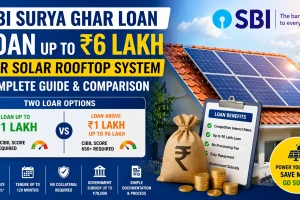
If you are planning to install a solar rooftop system at your home and thinking of taking a loan for it, then State Bank of India (SBI) can help you through its Surya Ghar Scheme. Under this scheme, SBI provides a loan for installing solar rooftop systems at very competitive interest rates compared to other regular loans.
SBI has designed two types of loans under the Surya Ghar Scheme for solar rooftop installation.
The first loan is available up to ₹1 lakh.
The second loan is available for amounts above ₹1 lakh and up to a maximum of ₹6 lakh.
In this article, we will do a side-by-side comparison of these two types of loans and understand the basic differences between them.
Purpose of the Loans
The first loan (up to ₹1 lakh) is meant for smaller solar rooftop projects.
The second loan is available if you want to take a loan between ₹1 lakh and ₹6 lakh.
Age and Eligibility Criteria
The age and eligibility criteria are the same for both types of loans.
For example, your age should not be more than 65 years. If you are taking the loan at the age of 65, the loan must be fully repaid by the time you reach 70 years of age.
If you have a co-borrower along with the individual borrower, then the loan must be fully repaid before the borrower reaches 75 years of age.
CIBIL Score Requirement
The CIBIL requirements differ for both loans.
For loans up to ₹1 lakh, the bank does not check your CIBIL score.
However, if the loan amount is more than ₹2 lakh, your CIBIL score must be a minimum of 650.
Customers who have had any default or loan write-off in the past will not be eligible for this loan from SBI.
Roof Ownership
The most important condition is that the roof on which you want to install the solar system must be owned by you. You can only install the solar rooftop on your own roof, and the loan is given against that.
Other Important Requirements
You must have sufficient roof area as per the guidelines issued by the Ministry of New and Renewable Energy (MNRE).
Your latest electricity bill is required.
You must have a savings account with SBI.
For loans up to ₹2 lakh, PAN card is not mandatory. However, if the loan amount is more than ₹2 lakh, PAN card is mandatory.
Margin Money
In both cases, the bank does not finance 100% of the project cost. You will have to contribute a 10% margin. For example, if your total project cost is ₹100, the bank will finance only ₹90.
Interest Rates
For loans up to ₹2 lakh: Interest rate is 6%.
For loans above ₹2 lakh: Interest rate is 8.15%.
Loan Tenure
You can repay the loan in a maximum of 120 months (10 years). There is no minimum tenure fixed. You can prepay the loan at any time without any prepayment penalty from the bank.
Security
You do not need to provide any additional security. The solar rooftop system installed on your roof will remain as hypothecation with the bank until the loan is fully repaid. This is similar to the hypothecation arrangement in a car loan.
Processing Fee
There is no processing fee or file charge for this loan.
Government Subsidy
The Government of India also provides subsidy on solar rooftop installation under this scheme:
For 1 kW solar rooftop: ₹30,000 subsidy
For 2 kW solar rooftop: ₹60,000 subsidy
For 3 kW solar rooftop: ₹78,000 subsidy
If your loan amount is more than ₹2 lakh, it will usually be for a project of 3 kW or above, and you will be eligible for the full ₹78,000 subsidy.
Income Requirement
For loans up to ₹1 lakh: Annual income is not considered.
For loans above ₹2 lakh: Minimum annual income of ₹3 lakh is required.
Documents Required
In both cases, you need to submit KYC documents and your latest electricity bill.
If the loan amount is more than ₹1 lakh, additional documents are required, such as:
Proof of income (ITR returns and Form 16 for the last 2 years)
Salary account statement for the last 6 months
Moratorium Period
A moratorium period of up to 6 months may be offered, during which you do not need to pay any instalments.
Loan Disbursement Process
The loan amount is disbursed directly to the vendor from whom you are purchasing and installing the solar system.
How to Apply
The basic process to apply for the SBI Surya Ghar Loan is as follows:
First, register on pmsy.gov.in
After successful registration, apply for the loan on www.jsarth.in
Submit all the required documents to the bank.
The bank will sanction the loan after checking your eligibility.
If you have any more doubts about the SBI Surya Ghar Loan, you can ask in the comment section below.
Recently, some important announcements related to the PM KUSUM scheme have also been made. Has the government ensured benefits for common people and farmers in it? Will 2026 see the highest number of solar panel installations ever?
Now that the budget is out, the big question is what has the solar industry received from this budget? In the coming days, will installing a solar panel system at home become cheaper or more expensive? Will subsidy be reduced or increased? And what announcements have been made regarding the PM KUSUM scheme? Has the government taken care of your benefits?
The government has laid out a complete roadmap for the solar sector in this budget. Let me explain everything in detail.
Major Announcements in Budget 2026 for Solar Sector
1. PM KUSUM Scheme 2.0 – Big Boost for Farmers
The government has announced PM KUSUM 2.0. The budget allocation for this scheme has been increased by 45%.
Subsidy for solar pumps used for irrigation has been increased.
Farmers can now install solar panel systems on barren land up to 2 MW capacity.
Approximately ₹500 crore has been allocated for this, which is a 45% increase from before.
This means the PM KUSUM scheme will now move forward at a much faster pace. Many farmers are already earning good income (₹6–7 lakh per month) by installing solar plants on their land. With this increased funding, more farmers can now benefit and increase their earnings significantly.
2. PM Surya Ghar Scheme – Higher Subsidy
Good news for homeowners! The subsidy under the PM Surya Ghar Muft Bijli Yojana has also been increased.
Earlier, for a 3 kW rooftop solar system, you used to get ₹78,000 subsidy.
Now, for a 2 kW system, the subsidy has been increased to ₹80,000.
For 1 kW system, subsidy was around ₹30,000 earlier. For 2 kW, it was ₹60,000. The government has now increased the subsidy amount by nearly ₹20,000.
This will make rooftop solar systems much more affordable for common people.
3. Strong Push for Domestic Solar Manufacturing
To promote “Make in India” in solar, the government has allocated ₹24,000 crore under the PLI (Production Linked Incentive) Scheme.
Earlier allocation was ₹19,000 crore.
Now it has been increased to ₹24,000 crore.
This will encourage more companies to set up solar panel and solar cell manufacturing factories in India.
4. Focus on Battery Storage (BESS)
The government has also proposed to reduce GST on Battery Energy Storage Systems (BESS). Earlier, hybrid and storage-based solar systems had 18% GST, while normal solar products had only 5%. Reducing GST on storage systems will make hybrid and off-grid solar systems cheaper in the coming days.
What Does This Mean for You?
Installing solar panel systems is going to become more attractive and affordable in 2026.
Farmers can earn extra income through PM KUSUM by installing solar plants on their land.
Homeowners will get higher subsidy under PM Surya Ghar scheme.
Domestic manufacturing is being strongly encouraged, which will help reduce dependence on imported panels in the long run.
I believe 2026 will see the highest number of solar installations in India so far.
My Advice
If you have not yet applied for solar under the PM Surya Ghar Yojana, don’t delay. Register yourself immediately on the official website: pmsuryaghar.gov.in
The more people apply, the longer the waiting time may become. So register early and take maximum advantage of the subsidy. The money you invest will recover quickly through electricity bill savings.
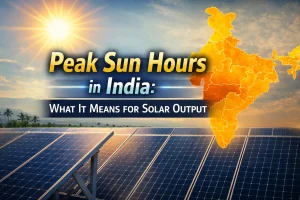
In this article, we will clearly understand the important concept of Peak Sun Hours and why it matters for anyone planning to install a solar power system.
Most people assume that all the sunlight available from sunrise to sunset can be used effectively by solar panels. However, this is not entirely accurate.
Understanding Peak Sun Hours
Sunlight intensity is not constant throughout the day. At sunrise, the intensity is low. It gradually increases and reaches its peak around noon. After that, it starts decreasing and becomes almost zero by sunset.
Peak Sun Hours is a standard way to measure the effective sunlight available in a day. It represents the number of hours during which the sunlight intensity is equal to 1000 watts per square meter — the standard test condition used for rating solar panels.
How Peak Sun Hours are Calculated
Scientists measure sunlight intensity every hour from sunrise to sunset at a specific location. They add up the total energy received throughout the day (in watt-hours per square meter) and then divide it by 1000.
For example: If a location receives a total of 5800 watt-hours per square meter in a day, then its Peak Sun Hours will be 5.8 hours.
This simple calculation helps us understand how much effective solar energy is available daily at any given place.
Why Peak Sun Hours Matter
The higher the Peak Sun Hours in your area, the better your solar panels will perform. You will get more electricity generation from your solar power system. On the other hand, locations with lower Peak Sun Hours will produce less power, and you may need to install a larger solar system to meet your energy needs.
Main Factors Affecting Peak Sun Hours
Several important factors influence Peak Sun Hours:
Earth’s Rotation – This causes day and night, leading to sunrise and sunset.
Earth’s Revolution around the Sun – This is responsible for seasons. Sunlight intensity is higher in summer and lower in winter.
Latitude – Locations closer to the equator receive stronger and more consistent sunlight. As we move towards the poles, sunlight intensity decreases.
Weather Conditions – Cloud cover, rain, fog, and air pollution can significantly reduce sunlight intensity.
Because of these factors, Peak Sun Hours vary from region to region. Areas with higher Peak Sun Hours are more suitable for solar power generation, while places with lower values require bigger solar installations to achieve the same output.
Generally, states in the western and central parts of India get the highest sunlight. On the other hand, northeastern states and Himalayan regions receive comparatively less sunlight.
States with High Sunlight (Good Peak Sun Hours)
These states are considered very good for solar power systems because they get strong and consistent sunlight:
Rajasthan — It receives the highest amount of sunlight in India, especially in the desert areas. Peak Sun Hours are excellent here.
Gujarat — This state also gets very good sunlight, particularly in the dry regions. It is one of the best states for solar energy.
Madhya Pradesh — Most parts of the state receive strong sunlight throughout the year.
Maharashtra — Many areas, especially the central and western parts, get good solar radiation.
Andhra Pradesh and Telangana — These states get high and consistent sunlight in most areas.
Karnataka — Northern and central parts of Karnataka receive good sunlight.
Tamil Nadu — Most parts get decent sunlight, though some coastal areas get affected during monsoon.
In these states, the average Peak Sun Hours are generally between 5 to 6+ hours per day in a year. Because of this, solar panels work very well and you can generate more electricity even with a smaller solar system.
States with Less Sunlight
Northeastern states like Arunachal Pradesh, Assam, Nagaland, Meghalaya, and Mizoram — These areas get less sunlight because of heavy rainfall and frequent clouds. Peak Sun Hours are usually lower here.
Himalayan states such as Himachal Pradesh, Uttarakhand, and Jammu & Kashmir — Due to hills and more clouds, sunlight intensity is lower in many places.
West Bengal, parts of Bihar, and Odisha — They get moderate sunlight, but during monsoon months it reduces a lot.
Why Does This Matter?
If you live in a state with high Peak Sun Hours (like Rajasthan, Gujarat, or Madhya Pradesh), your solar panels will produce more electricity. You may need fewer panels to meet your daily power needs.
But if you are in a state with lower Peak Sun Hours (like the Northeast), you might have to install a bigger solar system to get the same amount of electricity.
Understanding how much sunlight your state receives is very important before installing a solar power system. It helps you plan properly and gives you a realistic idea of how much power you can expect from your solar setup.
If you have any questions about Peak Sun Hours or want to know the Peak Sun Hours of your city, feel free to comment below.
Since the government started giving subsidy on hybrid solar systems, a large number of people have started moving towards hybrid setups. Installing a hybrid solar system offers several important benefits.
Earlier, subsidy was available only on on-grid systems. On-grid systems work only when grid electricity is available. If there is no power during the day, installing an on-grid system becomes almost useless.
This is why, in areas where power cuts are common, a hybrid solar system is an excellent choice. You get both battery backup during outages and the full benefit of solar generation. However, hybrid inverters available in the market today are somewhat costly. Transformer-based hybrid inverters are cheaper, but they come with a major disadvantage – higher power loss.
On the other hand, many reputed brands have now introduced transformer-less hybrid inverters. Most of these modern hybrid inverters from different brands are quite similar in features and performance, which is why their pricing is also almost the same.
At present, we have a 5 kW hybrid solar setup from Deye. However, it is not yet functioning at its full potential because net metering has not been completed.
If you are also planning to install a 5 kW hybrid solar system, this detailed guide will help you understand everything clearly.
Who Should Install a Hybrid Solar System?
A hybrid setup is suitable for almost everyone. But if you need both grid export (net metering) and battery backup, then a hybrid solar system is the best option.
A 5 kW hybrid setup is ideal for homes that consume around 25 units per day. If your daily consumption is higher, you may need a larger plant. If it is lower, a smaller system can also work.
With a 5 kW hybrid system, you can comfortably run two 1.5 ton air conditioners. If you choose a transformer-less inverter, you can run two 1 ton ACs along with other household loads without any issue.
Battery Backup Duration
If you install a lithium battery, you get precise and reliable backup. For example, with a 5 kWh lithium battery:
1 kW load → approx. 5 hours backup
5 kW load → approx. 1 hour backup
With lead-acid batteries, backup time drops significantly under heavy load. Running heavy loads on lead-acid batteries also reduces their lifespan quickly. Therefore, lithium batteries are highly recommended for heavy loads.
Cost Breakdown of 5 kW Hybrid Solar System (2026) Premium Setup (Transformer-less Technology – Deye Company):
Hybrid Inverter: ₹1,00,000
Lithium Battery: ₹1,10,000
Solar Panels (Top brand, Non-DCR): ₹80,000 – ₹1,00,000
Installation, Structure & Wiring: ₹50,000
Total Cost: Approx. ₹3.5 Lakh
If you want government subsidy, you need to use DCR solar panels, which increases the cost by around ₹50,000. However, you can get approximately ₹78,000 as central subsidy (plus state subsidy in some states like UP up to ₹18,000).
Budget-Friendly Options:
UTL / Eastman: Hybrid inverter ≈ ₹95,000, Lithium battery ≈ ₹80,000, Solar panels ≈ ₹1 Lakh or less
Total Cost: Approx. ₹2.5 Lakh to ₹3 Lakh
You can reduce the cost further by choosing lead-acid batteries instead of lithium (saves around ₹60,000).
Other brands like Servotech, Waaree, and Eastman also offer complete hybrid combos in the ₹3 Lakh range.
Important Advice
While choosing a hybrid solar system, always select a brand that provides good after-sales service in your area. A solar system is a long-term investment that can easily run for 15–20 years. Poor service can lead to major problems and financial loss later.
If you have any questions or suggestions regarding 5 kW hybrid solar systems, feel free to comment below.
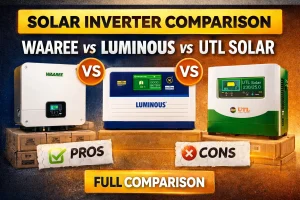
If you believe that the solar inverter you are about to install or have already installed at home will generate huge amounts of electricity and drastically reduce your power bill, then you may be mistaken. In this detailed comparison, we analyse three popular brands — Waaree, Luminous, and UTL solar inverters.
By the end of this article, you will realise that most people know only 20 to 30% of the real picture when it comes to solar inverters. A big brand name does not always mean superior performance. We will cover both the advantages and the disadvantages honestly so you can make an informed decision.
1. Waaree Energy
Waaree started its journey in 1989 and began manufacturing solar modules in 2007. The company has 5 to 6 manufacturing plants in India and one in the USA. Waaree offers on-grid, off-grid, and hybrid inverters. You can choose according to your requirement. The brand also supplies complete solar kits that include their own inverter. However, if you want to pair a Waaree inverter with panels from another brand, you can purchase it separately from their website.
Waaree inverters come with MPPT technology and are available in both single and dual MPPT options. Later in this article, we will introduce a company that uses RMPPT technology, which is claimed to be 10 to 15% more efficient than standard MPPT.
Waaree offers inverters ranging from 700 W to 136 kW, making them suitable for small as well as large solar plants. Their inverters deliver 99% MPPT efficiency and 97.4% maximum system efficiency. MPPT technology is far more advanced than the older PWM technology and can provide 20 to 30% higher energy production.
In terms of reliability and durability, a crucial factor in Indian conditions with extreme summer, winter, and monsoon, Waaree inverters are well-tested for Indian weather. They come with sturdy metal frames that handle temperature variations effectively.
Special features include smart monitoring system with anti-islanding protection and high voltage management. In the 1–5 kW segment, Waaree offers two models: F Series G2 and S Series G3. Both support 80–600 V voltage range, 14–20 A maximum input current, and are available in single or dual MPPT. Weight ranges between 5 kg to 14.5 kg, making them easy to wall-mount.
Price (1–5 kW single phase): ₹20,000 – ₹36,000 Warranty: 8 years standard (extendable up to 10, 12 or 15 years) After-sales service: Good in major cities; rural areas may face slight delays. Disadvantages: Occasional communication or server issues, auto shutdown in high temperature, possible internal damage due to moisture, and performance drop if regular maintenance and software updates are skipped.
2. Luminous
Luminous was founded in 1988 and entered the solar segment in 2014. In 2022, RR Cables acquired the company, and in 2024 they established a full-fledged solar manufacturing facility in Uttarakhand. Luminous offers a wide range of on-grid, off-grid, and hybrid inverters from 2 kW to 150 kW in single and triple phase.
Their inverters feature single and dual MPPT technology with 97.2% maximum efficiency. They use robust metal frame construction for long-term reliability. Notable features include high/low temperature and voltage warnings, boost charge, smart charge, and battery overload protection.
On-grid series is known as NXi, off-grid as NXC, and hybrid inverters come under TX and Solar series. Maximum MPPT voltage range is 70–550 V. Max input current is 16 A for on-grid and up to 30 A for hybrid models. On-grid inverters weigh 7–9 kg (easy wall mount), while off-grid and hybrid models weigh 15–34 kg and are recommended for floor mounting for safety.
Warranty: 5 years standard (extendable to 10 years) After-sales service: Excellent with over 60 registered vendors across India and technician visits usually within 24–48 hours. Disadvantages: Slightly higher price compared to competitors, batteries require frequent maintenance, and performance dips a little in low light conditions.
3. UTL Solar
UTL offers a wide range of on-grid, off-grid, and hybrid inverters from 1.5 kW to 136 kW. The biggest highlight of UTL is its RMPPT (Rapid Maximum Power Point Tracking) technology, which tracks solar input more rapidly and accurately than standard MPPT. This feature is currently unique to UTL inverters and can make a noticeable difference in long-term energy production. RMPPT efficiency is 99% and maximum system efficiency reaches 97.6%.
Voltage range is 70–500 V. Maximum input current is 13.5A for on-grid and 18A for hybrid models. On-grid inverters are lightweight (4.5–7.5 kg) and easy to wall-mount. Hybrid inverters weigh 12–17 kg, while off-grid models are heavier (32–50 kg) and need floor mounting.
Warranty: 10 years standard After-sales service: 3600+ dealers across India with rapid network expansion. Disadvantages: Build quality needs improvement, maximum input current is relatively low, and the remote monitoring system feels outdated.
Final Thoughts
If you have read this far, it shows you are serious about investing your hard-earned money wisely. We have covered specifications, features, pricing, warranty, service, and real disadvantages of all three brands.
Whether you finally choose Waaree, Luminous, UTL, or any other company, always compare specifications carefully before buying. We hope this detailed comparison helps you pick the right solar inverter for your needs.
I often get this question: “How many units of electricity does 1 kilowatt system actually generate in one day?”
In this detailed test, we answer that question by monitoring our current setup: two Waaree 575 W solar panels (total ~1.15 kW nameplate capacity) in an off-grid configuration. We tracked generation from early morning until late afternoon on 7 March to see the real maximum daily units produced.
Current Setup and Time of Observation
Time right now: 6:30 AM
Date: 7 March
Panels: 2 × Waaree 575 W (±2 W tolerance) – freshly cleaned this morning
Batteries: 4 batteries (approximately 24 V system)
Inverter: Normal 2 kVA inverter (not a pure solar hybrid)
Charge controller: MPPT charge controller in use
Key Factor: Battery Full → Generation Stops (Off-Grid Reality)
Electricity generation in an off-grid system depends on many factors. Importantly, if there is no proper battery bank or if the batteries reach full charge early, the system stops producing usable power even when the sun is shining brightly.
In our case, with four batteries, they typically become fully charged by around 12:00–12:30 PM. After that point, any additional solar power is essentially wasted (curtailed) because there is nowhere to store it and no large enough load to consume it.
Today’s goal was to minimize that wastage: once the batteries reached full charge, we deliberately connected maximum possible household load to utilize as much of the available solar power as possible and measure the true peak daily output.
Morning Check: Panel Specifications & Initial Charging
The panels are completely neat and clean (cleaned this morning). You can see residual water droplets in some shots — we do clean them regularly despite what some comments suggest.
Brand: Waaree
Rated wattage (front & back label): 575 W ±2 W
At 6:30 AM with light sunlight just starting:
Charging current to battery: ~1.2 A
Solar input: ~6.7 A
Instant power: ~24 W
Total generation so far this month (five months of data): around 7 units.
Mid-Morning Progress (Around 10–11 AM)
By ~10:06 AM:
Charging amps: ~30.4 A (from panels)
Incoming amps to battery: ~21 A
Battery voltage: ~26.9 V
Instant power from panels: ~780 W
By ~11:00 AM:
Charging amps dropped to ~3.3 A
Battery nearing 50% → expected to reach full in another 30–60 minutes
Instant power from panels: 924 W
Battery Full – Maximum Load Test (Around 12 PM)
At approximately 12:00 PM the battery reached full charge:
Battery voltage: 28.4 V (completely full – solar full indicator ON)
Still receiving 924 W from panels
Units generated so far: 2.7 units (with ~200 W average house load running during charging)
From this point we applied maximum realistic household load to consume the surplus solar power:
Loads turned ON (approximate breakdown)
Rod heaters (2 nos.)
LED bulbs across rooms (7 total, including 24/7 ones)
Ceiling fans (multiple)
Cooler (~200 W)
False ceiling lights (4 × 12 W = 48 W)
Tube lights
Monitor (runs 6 AM – 10/11 PM daily)
Fridge (was already running earlier)
Additional test lights
Inverter load reading after maximum load: ~33%
Afternoon Snapshot (Around 4:18 PM)
Time: 4:18 PM
Battery: Still showing 28.4 V (full)
House load running: ~10 A / 200–300 W
Panels still contributing ~200–300 W
Total units generated: 5.9 (almost 6 units)
Final Reading (Evening – 5:53 PM)
Time: 5:53 PM
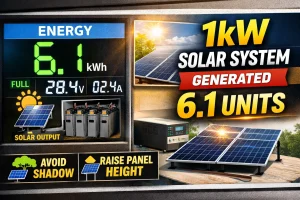
Total units generated for the day: 6.1 units
Very small charging (~1 A) still occurring
Summary of Results
From a ~1 kW (actually 1.15 kWp) off-grid solar setup with four batteries and a normal inverter, we generated 6.1 units on 7 March.
Had the panels been mounted higher (say 8 feet above ground), we estimate an additional 20–30% output was possible — potentially reaching around 7 units per day in similar conditions.
Why Not Higher Output? Two Main Reasons Observed
Wall shadow in late afternoon — As evening approaches, the nearby wall casts a shadow across the panels, reducing effective generation.
Tree shadow in early morning — Until around 8:00 AM, tree shade falls on the panels, delaying peak production.
Recommendations for Better Output
If you want to maximize units from a similar setup:
Install panels on a proper stand / higher elevation (at least 8 feet from ground) to avoid ground-level obstructions and shadows.
Consider a pure solar hybrid inverter for better direct utilization.
Size the battery bank larger if you frequently see early full-charge curtailment.
We hope this real-world test gives you a clear idea of what a 1 kW-class off-grid system can realistically deliver in everyday home use.
If you found this helpful, feel free to share your own solar generation numbers or setup questions in the comments!
Whenever we go to the market to buy solar panels, we get completely confused about which solar panel we should buy, how many watts we need, which technology is better. Apart from that, there are so many other questions in our mind about which we have zero knowledge.
Whenever we install a solar system, the most important part of the entire system is the solar panel. If you don’t select the right solar panel, then no matter how good the rest of the system (inverter, battery, wiring) is, it’s of no use.
That’s why when people decide to install solar, the top 5 questions they ask the most are the ones you should definitely know about.
1st most important point: Efficiency of solar panel
When you buy a solar panel, you must have seen it written on the panel — efficiency 14%, 15%, 20%, etc. What does this mean? Out of all the sunlight that falls on the panel, how much percentage of it is getting converted into electricity — that percentage is called efficiency.
2nd point: P-type vs N-type
Nowadays you hear the word N-type almost everywhere. Earlier it used to be mostly P-type, and many times they didn’t even mention it, just gave you the panel. Technically it’s a bit long to explain, but simply remember:
P-type → old technology
N-type → new & improved technology
N-type panels are much more efficient compared to P-type. The problems/weaknesses that were in P-type have mostly been removed in N-type.
But that doesn’t mean P-type panels are completely useless today. They had their time. Right now the latest panels coming in the market are almost all N-type. So just keep one thing in mind, whatever panel you buy today, make sure it is N-type.
3rd point: Watt rating
Since we buy solar panels to generate electricity, everything depends on how many watts the panel produces. For example: You see 500W, 540W, 550W panels in the market. If you want to install a 2 kW solar system, then you’ll need roughly four 540W panels (4 × 540 = 2160 W ≈ 2 kW+). So always calculate according to your required system size.
4th point: DCR vs Non-DCR
This is very simple to understand.
DCR (Domestic Content Requirement) → panels manufactured in India
Non-DCR → either fully imported or cells imported & assembled here (still counted as Non-DCR)
If you want subsidy under PM Surya Ghar Yojana (or any government scheme), then only DCR panels are eligible. Government is promoting Make in India, so they don’t give subsidy on imported / Non-DCR panels. So if subsidy is important for you → must buy DCR panels only.
5th point (most important — saved for last): A-grade vs B-grade
I’ll explain this at the end because it’s very critical.
Now let’s understand different types of solar panels in very simple language.
Evolution of solar panel technology (for home use):
Polycrystalline (first type, blue colour)
Efficiency: 13–16%
Oldest technology
Almost disappeared from market now
Monocrystalline
Efficiency: ~16–18% (2–3% better than poly)
Better temperature handling
Black colour mostly
Monoperc (PERC technology added)
Efficiency improved again (~1–1.5% more)
Cells improved → better performance
Monoperc Half-cut
Big improvement: cells are cut in half → panel divided into two electrical parts
Advantage: If shadow/dust falls on one half, the other half still works at full capacity
Earlier full-cell panels — even small shadow on one cell could reduce entire panel output drastically
Now you see 144 half-cells instead of 72 full cells
Bifacial (mostly comes with half-cut now)
Generates power from both front and back side
Front: 100%
Back: ~70% (albedo light — reflection from ground/roof)
Easy to identify: back side also looks like solar cells (not white sheet like normal panels)
So latest common name you hear today: Monoperc Half-cut Bifacial N-type
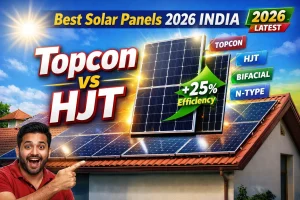
Topcon (Tunnel Oxide Passivated Contact)
Even more advanced than previous
Higher efficiency, higher wattage in same size (550–700 W common now)
Usually N-type + Half-cut + Bifacial + Topcon
HJT (Heterojunction Technology) — latest of all (2024–2026 period)
Efficiency: 23–23.5%+ (highest so far)
Very high wattage panels starting from 700–750 W already
Still expensive & mostly imported in India → used more in commercial projects
In future expected to reach 1 kW per panel
Quick summary: What should you buy in 2025–2026?
Best realistic choice right now for home users (balance of price, performance, availability & subsidy): Topcon Half-cut Bifacial N-type DCR panels (550–700W range)
HJT is superb but still costly and less available in DCR.
Most important: A-grade vs B-grade
This is the point many vendors never tell you.
A-grade: Perfect panel, no manufacturing defect, gives 100% rated output
B-grade: Some manufacturing defect (example: one cell damaged, spot on glass, etc.), output slightly less (maybe 3–10W less per panel)
B-grade panels are sold cheaper. Vendors push them without telling. Over time their efficiency drops faster, long-term loss for customer.
How to check?
Ask for flash test report (IV curve graph)
Good companies stick the flash report graph on back of panel or give copy inside box
Insist on A-grade only
Popular Indian brands right now (DCR eligible): Adani, Tata Power Solar, Waaree, Vikram Solar, Renewsys, etc.
Always cross-check price online + local market + company website. Don’t fall for very cheap “deal,” usually old stock or B-grade.