Is Solar Expensive in India? Cost vs Benefits

Is Solar Expensive in India

If you’re thinking about installing a solar system in India to reduce your electricity bills, run ACs comfortably, or achieve energy independence, you’re in the right place. Many people wonder: Is solar expensive in India? The short answer is no, not anymore, especially with heavy government subsidies and excellent long-term returns. Let’s break it down in simple terms: costs, types, subsidies, savings, and benefits.

What Are Solar Panels?

Solar panels (also called solar plates or PV modules) work on the photovoltaic principle. “Photo” means light and “voltaic” means electricity. They convert sunlight directly into DC electricity. Since most Indian homes use AC power, an inverter converts DC to AC.

Solar panels typically last 25+ years, with newer ones performing well even after 30-35 years, though efficiency drops slightly over time.

Types of Solar Panels

There are mainly three types:

  • Polycrystalline (Blue colour): Cheapest option. Good for tight budgets but slightly lower efficiency.
  • Monocrystalline (Black colour): More efficient and popular for better performance.
  • Bifacial Monocrystalline: Premium choice. Generates power from both sides (top and reflected light from bottom). Higher output, especially in open areas.

Your choice depends on budget — mono or bifacial for better long-term results.

Types of Solar Systems in India

  1. On-Grid System (Most Popular for Homes): This works with your existing electricity connection. Solar power feeds into your home and the grid. When solar produces enough, your meter slows down or runs backwards (net metering). No batteries needed. Best for: Areas with reliable grid power. Government subsidies are mainly available for on-grid systems.
  2. Off-Grid System: Completely independent with batteries. Solar charges batteries, and the inverter supplies power. Ideal for remote areas, villages, or places with frequent power cuts. Drawback: Batteries need replacement every 5-8 years (they are consumables).
  3. Hybrid System: The best of both worlds. Works with grid + solar + battery backup. Runs on solar/grid when available and switches to battery during outages. Slightly more expensive but most versatile.

Is Solar Expensive? Real Cost Breakdown (2026)

For a typical 3kW On-Grid System (recommended for most 3-4 BHK homes):

  • Gross Cost: ₹1.75 lakh to ₹2.5 lakh (including panels, inverter, installation, etc.).
  • Central Government Subsidy (PM Surya Ghar Muft Bijli Yojana): ₹78,000 fixed for 3kW and above.
  • State Subsidies: Vary by state (e.g., some states like UP, Delhi offer extra ₹15,000–₹30,000+). Total subsidy can reach ₹1 lakh+ in supportive states.
  • Net Cost to You: Often ₹70,000 to ₹1.5 lakh depending on brand, location, and state incentives.

Payback Period: Usually 3 to 5 years. After that, it’s mostly free electricity for the next 20+ years.

Cost vs Benefits: The Savings Calculation

According to the video and general data:

  • 1kW system generates roughly ₹2,000–₹2,500 worth of electricity per month (at ₹7-8 per unit).
  • 3kW system can generate 360–450 units per month (12-15 units/day), saving ₹3,000 to ₹5,000+ per month or ₹40,000–₹60,000 per year.

Example for Average Home:

  • Monthly bill without solar: ₹4,000–₹6,000
  • With 3kW solar: Bill drops dramatically (often to ₹500–₹1,500 or zero in good months)
  • 25-year savings: Can easily cross ₹10–15 lakh (considering rising electricity tariffs).

For running ACs: A 3kW system can comfortably handle 1-1.5 ton AC + normal household load (fans, fridge, lights, TV).

Who Should Go for Solar?

  • On-Grid: Best for most city/town homes with good grid supply → maximum subsidy + fastest payback.
  • Hybrid: If you face frequent power cuts.
  • Off-Grid: Remote locations or complete independence.

Pro Tip: Start with 3kW for best subsidy value. You can always expand later, but subsidy is capped effectively after 3kW.

Final Verdict: Is Solar Worth It in India?

Absolutely yes. What looks like a big upfront cost becomes one of the smartest investments you can make. With subsidies making net cost very reasonable, rising electricity prices, and 25+ years of benefits, solar pays for itself quickly and then starts giving “profit” in the form of near-zero bills.
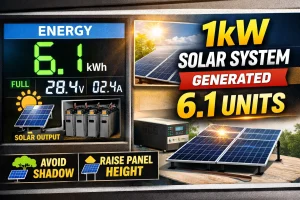
How many Units does 1kW Solar System generate in India?

units per 1kw solar power

I often get this question: “How many units of electricity does 1 kilowatt system actually generate in one day?”

In this detailed test, we answer that question by monitoring our current setup: two Waaree 575 W solar panels (total ~1.15 kW nameplate capacity) in an off-grid configuration. We tracked generation from early morning until late afternoon on 7 March to see the real maximum daily units produced.

Current Setup and Time of Observation

  • Time right now: 6:30 AM
  • Date: 7 March
  • Panels: 2 × Waaree 575 W (±2 W tolerance) – freshly cleaned this morning
  • Batteries: 4 batteries (approximately 24 V system)
  • Inverter: Normal 2 kVA inverter (not a pure solar hybrid)
  • Charge controller: MPPT charge controller in use

Key Factor: Battery Full → Generation Stops (Off-Grid Reality)
Electricity generation in an off-grid system depends on many factors. Importantly, if there is no proper battery bank or if the batteries reach full charge early, the system stops producing usable power even when the sun is shining brightly.

In our case, with four batteries, they typically become fully charged by around 12:00–12:30 PM. After that point, any additional solar power is essentially wasted (curtailed) because there is nowhere to store it and no large enough load to consume it.

Today’s goal was to minimize that wastage: once the batteries reached full charge, we deliberately connected maximum possible household load to utilize as much of the available solar power as possible and measure the true peak daily output.

Morning Check: Panel Specifications & Initial Charging
The panels are completely neat and clean (cleaned this morning). You can see residual water droplets in some shots — we do clean them regularly despite what some comments suggest.

  • Brand: Waaree
  • Rated wattage (front & back label): 575 W ±2 W

At 6:30 AM with light sunlight just starting:

  • Charging current to battery: ~1.2 A
  • Solar input: ~6.7 A
  • Instant power: ~24 W

Total generation so far this month (five months of data): around 7 units.

Mid-Morning Progress (Around 10–11 AM)
By ~10:06 AM:

  • Charging amps: ~30.4 A (from panels)
  • Incoming amps to battery: ~21 A
  • Battery voltage: ~26.9 V
  • Instant power from panels: ~780 W

By ~11:00 AM:

  • Charging amps dropped to ~3.3 A
  • Battery nearing 50% → expected to reach full in another 30–60 minutes
  • Instant power from panels: 924 W

Battery Full – Maximum Load Test (Around 12 PM)
At approximately 12:00 PM the battery reached full charge:

  • Battery voltage: 28.4 V (completely full – solar full indicator ON)
  • Still receiving 924 W from panels
  • Units generated so far: 2.7 units (with ~200 W average house load running during charging)

From this point we applied maximum realistic household load to consume the surplus solar power:

Loads turned ON (approximate breakdown)

  • Rod heaters (2 nos.)
  • LED bulbs across rooms (7 total, including 24/7 ones)
  • Ceiling fans (multiple)
  • Cooler (~200 W)
  • False ceiling lights (4 × 12 W = 48 W)
  • Tube lights
  • Monitor (runs 6 AM – 10/11 PM daily)
  • Fridge (was already running earlier)
  • Additional test lights

Inverter load reading after maximum load: ~33%

Afternoon Snapshot (Around 4:18 PM)

  • Time: 4:18 PM
  • Battery: Still showing 28.4 V (full)
  • House load running: ~10 A / 200–300 W
  • Panels still contributing ~200–300 W
  • Total units generated: 5.9 (almost 6 units)

Final Reading (Evening – 5:53 PM)

  • Time: 5:53 PM
  • Total units generated for the day: 6.1 units
  • Very small charging (~1 A) still occurring

Summary of Results
From a ~1 kW (actually 1.15 kWp) off-grid solar setup with four batteries and a normal inverter, we generated 6.1 units on 7 March.

Had the panels been mounted higher (say 8 feet above ground), we estimate an additional 20–30% output was possible — potentially reaching around 7 units per day in similar conditions.

Why Not Higher Output? Two Main Reasons Observed

  1. Wall shadow in late afternoon — As evening approaches, the nearby wall casts a shadow across the panels, reducing effective generation.
  2. Tree shadow in early morning — Until around 8:00 AM, tree shade falls on the panels, delaying peak production.

Recommendations for Better Output
If you want to maximize units from a similar setup:

  • Install panels on a proper stand / higher elevation (at least 8 feet from ground) to avoid ground-level obstructions and shadows.
  • Consider a pure solar hybrid inverter for better direct utilization.
  • Size the battery bank larger if you frequently see early full-charge curtailment.

We hope this real-world test gives you a clear idea of what a 1 kW-class off-grid system can realistically deliver in everyday home use.

If you found this helpful, feel free to share your own solar generation numbers or setup questions in the comments!