Best Solar Inverter for Homes in India – 2026 Guide
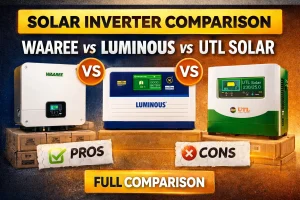
If you believe that the solar inverter you are about to install or have already installed at home will generate huge amounts of electricity and drastically reduce your power bill, then you may be mistaken. In this detailed comparison, we analyse three popular brands — Waaree, Luminous, and UTL solar inverters.
By the end of this article, you will realise that most people know only 20 to 30% of the real picture when it comes to solar inverters. A big brand name does not always mean superior performance. We will cover both the advantages and the disadvantages honestly so you can make an informed decision.
1. Waaree Energy
Waaree started its journey in 1989 and began manufacturing solar modules in 2007. The company has 5 to 6 manufacturing plants in India and one in the USA. Waaree offers on-grid, off-grid, and hybrid inverters. You can choose according to your requirement. The brand also supplies complete solar kits that include their own inverter. However, if you want to pair a Waaree inverter with panels from another brand, you can purchase it separately from their website.
Waaree inverters come with MPPT technology and are available in both single and dual MPPT options. Later in this article, we will introduce a company that uses RMPPT technology, which is claimed to be 10 to 15% more efficient than standard MPPT.
Waaree offers inverters ranging from 700 W to 136 kW, making them suitable for small as well as large solar plants. Their inverters deliver 99% MPPT efficiency and 97.4% maximum system efficiency. MPPT technology is far more advanced than the older PWM technology and can provide 20 to 30% higher energy production.
In terms of reliability and durability, a crucial factor in Indian conditions with extreme summer, winter, and monsoon, Waaree inverters are well-tested for Indian weather. They come with sturdy metal frames that handle temperature variations effectively.
Special features include smart monitoring system with anti-islanding protection and high voltage management. In the 1–5 kW segment, Waaree offers two models: F Series G2 and S Series G3. Both support 80–600 V voltage range, 14–20 A maximum input current, and are available in single or dual MPPT. Weight ranges between 5 kg to 14.5 kg, making them easy to wall-mount.
Price (1–5 kW single phase): ₹20,000 – ₹36,000
Warranty: 8 years standard (extendable up to 10, 12 or 15 years)
After-sales service: Good in major cities; rural areas may face slight delays.
Disadvantages: Occasional communication or server issues, auto shutdown in high temperature, possible internal damage due to moisture, and performance drop if regular maintenance and software updates are skipped.
2. Luminous
Luminous was founded in 1988 and entered the solar segment in 2014. In 2022, RR Cables acquired the company, and in 2024 they established a full-fledged solar manufacturing facility in Uttarakhand. Luminous offers a wide range of on-grid, off-grid, and hybrid inverters from 2 kW to 150 kW in single and triple phase.
Their inverters feature single and dual MPPT technology with 97.2% maximum efficiency. They use robust metal frame construction for long-term reliability. Notable features include high/low temperature and voltage warnings, boost charge, smart charge, and battery overload protection.
On-grid series is known as NXi, off-grid as NXC, and hybrid inverters come under TX and Solar series. Maximum MPPT voltage range is 70–550 V. Max input current is 16 A for on-grid and up to 30 A for hybrid models. On-grid inverters weigh 7–9 kg (easy wall mount), while off-grid and hybrid models weigh 15–34 kg and are recommended for floor mounting for safety.
Price range (1–5 kW):
On-grid: ₹25,000 – ₹45,000
Off-grid: ₹23,000 – ₹50,000
Hybrid: ₹28,000 – ₹62,000
Warranty: 5 years standard (extendable to 10 years)
After-sales service: Excellent with over 60 registered vendors across India and technician visits usually within 24–48 hours.
Disadvantages: Slightly higher price compared to competitors, batteries require frequent maintenance, and performance dips a little in low light conditions.
3. UTL Solar
UTL offers a wide range of on-grid, off-grid, and hybrid inverters from 1.5 kW to 136 kW. The biggest highlight of UTL is its RMPPT (Rapid Maximum Power Point Tracking) technology, which tracks solar input more rapidly and accurately than standard MPPT. This feature is currently unique to UTL inverters and can make a noticeable difference in long-term energy production. RMPPT efficiency is 99% and maximum system efficiency reaches 97.6%.
Voltage range is 70–500 V. Maximum input current is 13.5A for on-grid and 18A for hybrid models. On-grid inverters are lightweight (4.5–7.5 kg) and easy to wall-mount. Hybrid inverters weigh 12–17 kg, while off-grid models are heavier (32–50 kg) and need floor mounting.
Price range:
On-grid: ₹16,000 – ₹35,000
Hybrid: ₹35,000 – ₹65,000
Off-grid: ₹14,000 – ₹3,20,000
Warranty: 10 years standard
After-sales service: 3600+ dealers across India with rapid network expansion.
Disadvantages: Build quality needs improvement, maximum input current is relatively low, and the remote monitoring system feels outdated.
Final Thoughts
If you have read this far, it shows you are serious about investing your hard-earned money wisely. We have covered specifications, features, pricing, warranty, service, and real disadvantages of all three brands.
Whether you finally choose Waaree, Luminous, UTL, or any other company, always compare specifications carefully before buying. We hope this detailed comparison helps you pick the right solar inverter for your needs.