How many Units does 1kW Solar System generate in India?
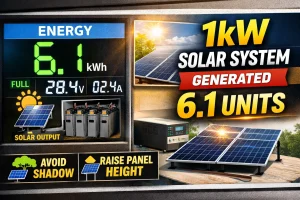
I often get this question: “How many units of electricity does 1 kilowatt system actually generate in one day?”
In this detailed test, we answer that question by monitoring our current setup: two Waaree 575 W solar panels (total ~1.15 kW nameplate capacity) in an off-grid configuration. We tracked generation from early morning until late afternoon on 7 March to see the real maximum daily units produced.
Current Setup and Time of Observation
- Time right now: 6:30 AM
- Date: 7 March
- Panels: 2 × Waaree 575 W (±2 W tolerance) – freshly cleaned this morning
- Batteries: 4 batteries (approximately 24 V system)
- Inverter: Normal 2 kVA inverter (not a pure solar hybrid)
- Charge controller: MPPT charge controller in use
Key Factor: Battery Full → Generation Stops (Off-Grid Reality)
Electricity generation in an off-grid system depends on many factors. Importantly, if there is no proper battery bank or if the batteries reach full charge early, the system stops producing usable power even when the sun is shining brightly.
In our case, with four batteries, they typically become fully charged by around 12:00–12:30 PM. After that point, any additional solar power is essentially wasted (curtailed) because there is nowhere to store it and no large enough load to consume it.
Today’s goal was to minimize that wastage: once the batteries reached full charge, we deliberately connected maximum possible household load to utilize as much of the available solar power as possible and measure the true peak daily output.
Morning Check: Panel Specifications & Initial Charging
The panels are completely neat and clean (cleaned this morning). You can see residual water droplets in some shots — we do clean them regularly despite what some comments suggest.
- Brand: Waaree
- Rated wattage (front & back label): 575 W ±2 W
At 6:30 AM with light sunlight just starting:
- Charging current to battery: ~1.2 A
- Solar input: ~6.7 A
- Instant power: ~24 W
Total generation so far this month (five months of data): around 7 units.
Mid-Morning Progress (Around 10–11 AM)
By ~10:06 AM:
- Charging amps: ~30.4 A (from panels)
- Incoming amps to battery: ~21 A
- Battery voltage: ~26.9 V
- Instant power from panels: ~780 W
By ~11:00 AM:
- Charging amps dropped to ~3.3 A
- Battery nearing 50% → expected to reach full in another 30–60 minutes
- Instant power from panels: 924 W
Battery Full – Maximum Load Test (Around 12 PM)
At approximately 12:00 PM the battery reached full charge:
- Battery voltage: 28.4 V (completely full – solar full indicator ON)
- Still receiving 924 W from panels
- Units generated so far: 2.7 units (with ~200 W average house load running during charging)
From this point we applied maximum realistic household load to consume the surplus solar power:
Loads turned ON (approximate breakdown)
- Rod heaters (2 nos.)
- LED bulbs across rooms (7 total, including 24/7 ones)
- Ceiling fans (multiple)
- Cooler (~200 W)
- False ceiling lights (4 × 12 W = 48 W)
- Tube lights
- Monitor (runs 6 AM – 10/11 PM daily)
- Fridge (was already running earlier)
- Additional test lights
Inverter load reading after maximum load: ~33%
Afternoon Snapshot (Around 4:18 PM)
- Time: 4:18 PM
- Battery: Still showing 28.4 V (full)
- House load running: ~10 A / 200–300 W
- Panels still contributing ~200–300 W
- Total units generated: 5.9 (almost 6 units)
Final Reading (Evening – 5:53 PM)
- Time: 5:53 PM
- Total units generated for the day: 6.1 units
- Very small charging (~1 A) still occurring
Summary of Results
From a ~1 kW (actually 1.15 kWp) off-grid solar setup with four batteries and a normal inverter, we generated 6.1 units on 7 March.
Had the panels been mounted higher (say 8 feet above ground), we estimate an additional 20–30% output was possible — potentially reaching around 7 units per day in similar conditions.
Why Not Higher Output? Two Main Reasons Observed
- Wall shadow in late afternoon — As evening approaches, the nearby wall casts a shadow across the panels, reducing effective generation.
- Tree shadow in early morning — Until around 8:00 AM, tree shade falls on the panels, delaying peak production.
Recommendations for Better Output
If you want to maximize units from a similar setup:
- Install panels on a proper stand / higher elevation (at least 8 feet from ground) to avoid ground-level obstructions and shadows.
- Consider a pure solar hybrid inverter for better direct utilization.
- Size the battery bank larger if you frequently see early full-charge curtailment.
We hope this real-world test gives you a clear idea of what a 1 kW-class off-grid system can realistically deliver in everyday home use.
If you found this helpful, feel free to share your own solar generation numbers or setup questions in the comments!